Header logo

header top contact widget
 call us at
dental specialist
Advantages of Dental Implants Are Many
Posted on Jan 18, 2017 by William J. Claiborne, DDS MS
When a patient is missing natural teeth or describes trying to eat with a ‘wobbly’ denture, I spend time explaining the advantages of Dental Implants. Although patients may also be considering other options, I find many don’t realize the unexpected future costs associated with less expensive methods.
Here are a few of the many reasons we feel make Dental Implants the ideal tooth replacement option:
• Dental Implants restore biting strength and chewing stability: Dental Implants are supported by the upper or lower jaw bone, just as natural tooth roots. After implants are placed in the bone, the bone grows around them to fully secure them in the jaw. This enables confident biting and chewing without fear of embarrassing slips or uncomfortable rubbing.
• Dental Implants help to prevent declining mass of the jaw bone: When natural tooth roots no longer exist in the jaw, the bone that once held them no longer has the nourishment and stimulation once channeled through the roots. This causes the bone to shrink and what continually changes the fit of a denture or partial. In addition to undependable biting and chewing, bone loss causes changes in facial appearance that are aging far beyond one’s actual years. An implant restores stimulation to the bone and halts the progress of bone loss.
• Dental Implants are successful: Dental Implants have one of the highest success rates of any in-bone implant in the body, including hips and knees. When properly selected, placed and maintained, they are designed to last your lifetime.
• Dental Implants are a one-time expense: Because Dental Implants do not decay, require root canals, crack or break, future expense for upkeep or repairs is not needed. The material they are made of biologically integrates with living bone and is not rejected nor will it cause adverse reactions to surrounding structures. With proper care, they will last as long throughout your life.
• Dental Implants do not rely on neighboring teeth for support: Unlike crown-&-bridge combinations or partials, Dental Implants do not depend on adjacent teeth. And, because they help to preserve the bone that supports neighboring teeth, they are actually beneficial to the life of other natural teeth.
• Dental Implants support your overall health: The ability to eat a diet rich in healthy, fibrous and protein-rich foods enables our bodies to function properly. And, the ability to eat without fear of embarrassing moments or uncomfortable rubbing instills the confidence to be socially active. Because many social settings are centered around food, people who have Dental Implants know they can confidently eat, laugh and speak closely with others.
• Dental Implants are a ‘no regrets’ method of tooth replacement: I’ve never had one patient who felt their implants were anything but “the best investment I’ve ever made!”
For some people, the only ‘challenge’ when it comes to Dental Implants is the all-upfront expense. While they are an excellent investment, implant fees are paid before treatment completion. Budget constraints make some people uneasy with this type of commitment, especially when they’ve become used to a minimal investment and limited insurance coverage for most dentistry each year.
Some dental insurances tend to label Dental Implants as elective, as dentures and bridges require less coverage. However, when patients decide they will not allow an insurance company to dictate their health, comfort and self-confidence, insurance coverage becomes less important.
We believe an educated patient makes decisions that are best for their needs. To discuss replacing teeth with Dental Implants, call (828) 274-9440 to schedule a consultation. I’ll be happy to answer your questions and discuss potential treatment expenses.
Dental Implants – Understanding Their Components
Posted on Jan 18, 2017 by William J. Claiborne, DDS MS
They say knowledge is power. I believe the more a patient understands, the better participants they become in managing their oral health. When considering Dental Implants to replace missing teeth, understanding how the different components of an implant system works is the first step for patients, in my opinion.
Even though there are different types of implants to accommodate various needs, most systems work in the same way. Read on for a simple explanation of how implants are structured.
A Dental Implant is not a replacement tooth (or teeth). The tooth attached to the implant is actually a crown, or in some cases, a bridge of two or more teeth or a full arch (denture). The teeth are actually referred to as restorations, because they restore the look, feel and function of natural teeth.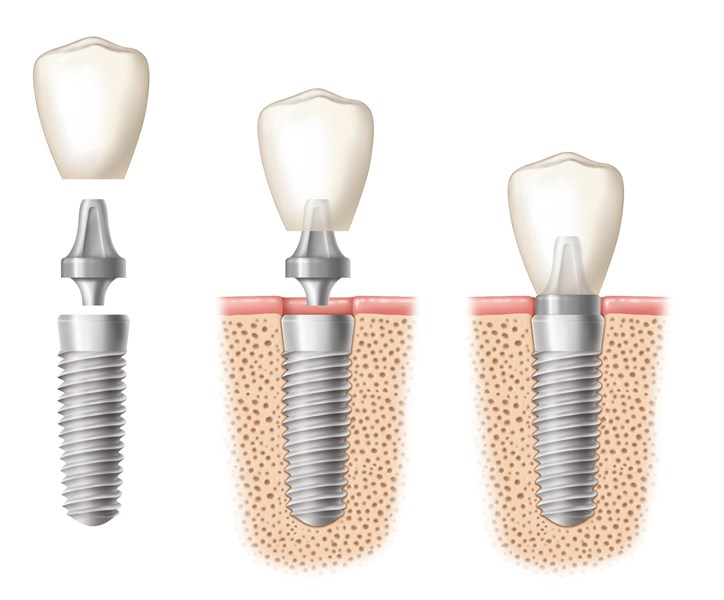
The implant is actually the portion placed in the jaw. An insertion point is made in the bone and the implant, a hollow screw-like cylinder, is placed. In most cases, the implants are recovered with gum tissue and allowed to heal for several months. During this time, you’ll be able to wear a denture or temporary teeth comfortably.
In the healing period, your jaw bone will grow around the implant, securing it in place. This process is known as osseo-integration, or integrating the implant with the bone. This recreates the presence of natural tooth roots, assuring biting and chewing stability.
After the healing process, the gum tissue is uncovered and a post is secured inside the implant. Onto this post, your final replacement tooth or teeth are attached.
An important aspect of successful Dental Implant treatment is in the selection and placement process. This is where a doctor who is highly trained and experienced is important. Sufficient bone mass must exist to hold the implant and adequately support the teeth being attached. By strategic placement at a proper depth, as few as 4 – 6 implants can support a full arch.
When bone loss is severe, bone rebuilding procedures can be performed prior to implant placement. This does not necessarily involve bone grafting. Additionally, some implant systems are designed to be placed at specific angles. This gives each implant the ability to support teeth without requiring much bone depth.
The type of Dental Implant system best suited for your needs can be discussed during a Consultation. As a Periodontist, I have advanced training and skills in the diagnosis an placement of all types of implants. During this time, I’ll explain options that will work best for you and answer your questions.
Call (828) 274-9440 to schedule a time when we can meet personally.
To Floss Or Not. The Debate Goes On.
Posted on Jan 10, 2017 by William J. Claiborne, DDS MS
I’m not fond of taking out the trash. It’s one of those chores I don’t like to do and only do it because I know the consequences of ignoring a full trash can. I take the trash out each day because I’d rather spend those few minutes doing it than have smelly odors (and no telling what else!) emanating from the kitchen can.
As a specialist in treating periodontal disease, I have encouraged countless patients over the years to spend 1-2 minutes a day flossing their teeth. It’s not something anyone particularly enjoys. It’s just one of those things that, in my opinion, is well worth the time and energy.
Brushing teeth doesn’t always remove debris in the mouth. Flossing helps to remove food particles caught between teeth that a tooth brush cannot reach or dislodge. Removing this debris is important before the particles begin to break down and ‘feed’ oral bacteria.
As food particles remain in the mouth, oral bacteria thrive. While they consume, bacteria multiply. This means the more bacteria present, the more there are to multiply. This occurs so rapidly that the sticky film you feel on teeth at the end of a day is simply a coating of oral bacteria that has accumulated since your morning brushing.
This film, by the way, is known as plaque, which coats the teeth, tongue and gums. When not removed on a frequent basis, plaque can form cement-hard bacteria colonies that attach to teeth. This hardened form of bacteria is known as tartar (or calculus) and is what your hygienist is scraping off during dental cleanings. Once formed, tartar cannot be brushed or flossed away.
Obviously, keeping oral bacteria levels to a minimum is an important part of avoiding problems such as cavities and gum disease. Brushing and flossing are the tried-&-true standards for accomplishing this. However, like most things, a proper technique is needed to truly make a difference.
Just how important is technique? A study conducted by the University of Washington School of Dentistry found that when children between ages 4 – 13 had their teeth professionally flossed five days a week for a year and a half, there was 40% drop in cavity risk. The same age group who flossed on their own saw no such benefit.
This is one of the reasons many dentists and periodontists recommend water flossers. They are easy to use, affordable and often more effective than the flossing techniques of most people, adults and adolescents alike.
There have been debates in the dental profession on past studies that claim flossing provides little benefit. Some feel study participants were not followed long enough to determine true effectiveness and proper flossing techniques were not monitored. However, there is no debate regarding the benefits of keeping bacteria levels in the mouth to a minimum.
In spite of daily flossing and twice daily brushing, other factors can impact your potential for a healthy mouth. Every time you eat, an acid attack begins in your mouth. While this is the initial part of the digestive process, this acid places tooth enamel in a vulnerable position. For those who are frequent snackers, they have higher risk of oral problems since their frequent eating triggers more acid attacks during the day.
This is also true for people who sip colas during the day. When the acid in the soda combines with the drink’s sticky sugar, its potency doubles when it mixes with the acid in the mouth. This double-whammy of acid is a direct path to cavities and other problems.
If non-flossers could see the number of adults I’ve seen who have lost teeth due to insufficient oral hygiene, flossing wouldn’t look like such a chore. Regardless of the debate on flossing, taking an additional measure for fresher breath, fewer cavities and healthier gums is worth the small amount of effort needed.
Is It Your Bad Breath They’ll Remember?
Posted on Jan 05, 2017 by William J. Claiborne, DDS MS
Business Insider says you have just 7 seconds to make a first impression. (http://www.businessinsider.com/only-7-seconds-to-make-first-impression-2013-4). That’s not a lot of time, but just enough to make a lasting impression. If you’ve ever met someone who has bad breath, that memory seems to stand out far more than if they had a piece of spinach in their teeth, for example.
No one wants to be associated with bad breath. If you suspect you have bad breath, you probably do. We all have occasional bad breath, but frequent bad breath is a symptom of periodontal disease. This is often accompanied by tender gums that bleed when brushing. As the disease progresses, your gums will darken in color and recede from teeth. Without treatment, teeth will eventually loosen and may require removal.
However, occasional bad breath has one origin – oral bacteria. Accumulated oral bacteria are the source of about every problem that occurs in your mouth. A few simple measures can help you keep oral bacteria to a minimum an enjoy the confidence of fresh breath and being close with others.
Oral bacteria are living, eating and reproducing organisms that thrive on rotting food in the mouth. As they accumulate, a sticky film known as plaque forms. If not brushed away daily, plaque hardens on teeth into tartar (or calculus). This cement-hard form of bacteria attacks tooth enamel and eats away at tender gum tissues.
When gum disease is the source of persistent bad breath, it produces a foul odor in the mouth even shortly after brushing. Gum chewing and mints may temporarily camouflage the odor, but not for long. Because the tissues in the mouth are continuously being destroyed, the lingering odor prevails, even after brushing.
Dry mouth is a contributing factor to bad breath, primarily because oral bacteria can rapidly reproduce when not regularly cleansed away through saliva. Saliva is designed to sweep bacteria from the mouth on a consistent basis. Without sufficient saliva flow, bacteria are able to accumulate at a more rapid pace.
Some causes for dry mouth are smoking, certain illnesses, snoring, mouth-breathing, and side effects of some medications. Drinking alcohol and caffeinated beverages are also drying to the mouth. The aging process can leave adults with insufficient saliva flow as well.
When you feel your mouth is dry, the ideal aid to saliva is drinking filtered water. Water is the perfect beverage when it comes to supporting your oral health. It also helps to keep your body hydrated, which aids in its overall function. Chewing sugarless gum is another way to help saliva flow and advised after meals when brushing is not possible.
The tongue is another source of oral bacteria. With its tiny grooves, bacteria embed in the tongue and enjoy a warm, moist haven for reproduction. This is why using a tongue scrapper daily or brushing the tongue with your tooth brush can significantly reduce the amount of bacteria in your mouth. Be sure to get to the back of the tongue where the majority of oral bacteria are embedded.
The bottom line to having fresh breath is to control the bacteria levels in your mouth. Begin with a clean mouth through your six-month dental cleanings and exams. These appointments help to remove buildup that has accumulated between visits, reducing the amount of bacteria in the mouth.
Then, renew your commitment for a thorough at-home regimen. Brush for at least two minutes twice daily, floss daily and use a tongue scraper or brush your tongue. Drink lots of water throughout the day. Avoid sugary treats and drinks since bacteria are super-charged by sugars and carbohydrates. Limit caffeine and quit smoking. Swish after eating or drinking, especially caffeinated or alcoholic beverages, to counteract drying effects.
Love your mouth and your reward will be fresh breath and a healthy smile. If your breath is frequent or you are seeing blood in the sink when brushing, call 828-274-9440 to schedule an appointment. Gum disease will only worsen without treatment.
Recent Posts
Categories
Archives
- September 2024
- August 2024
- July 2024
- June 2024
- May 2024
- April 2024
- March 2024
- February 2024
- January 2024
- December 2023
- November 2023
- October 2023
- September 2023
- August 2023
- July 2023
- June 2023
- May 2023
- April 2023
- March 2023
- February 2023
- January 2023
- December 2022
- November 2022
- October 2022
- September 2022
- August 2022
- July 2022
- June 2022
- May 2022
- April 2022
- March 2022
- February 2022
- January 2022
- December 2021
- November 2021
- October 2021
- September 2021
- August 2021
- July 2021
- June 2021
- May 2021
- April 2021
- March 2021
- February 2021
- January 2021
- December 2020
- November 2020
- October 2020
- September 2020
- August 2020
- July 2020
- June 2020
- May 2020
- April 2020
- March 2020
- February 2020
- January 2020
- December 2019
- November 2019
- October 2019
- September 2019
- August 2019
- July 2019
- June 2019
- May 2019
- April 2019
- March 2019
- February 2019
- January 2019
- December 2018
- November 2018
- October 2018
- September 2018
- August 2018
- July 2018
- June 2018
- May 2018
- April 2018
- March 2018
- February 2018
- January 2018
- December 2017
- November 2017
- October 2017
- September 2017
- August 2017
- July 2017
- June 2017
- May 2017
- April 2017
- March 2017
- February 2017
- January 2017
- December 2016
- November 2016
- October 2016
- September 2016
- August 2016
- July 2016
- June 2016
- May 2016
- April 2016
- March 2016
- February 2016
- January 2016
- December 2015
- November 2015
- October 2015
- September 2015
- August 2015
- July 2015
- June 2015
- May 2015
- April 2015
- March 2015
- February 2015
- January 2015
- December 2014
- November 2014
- October 2014
- September 2014
- August 2014
- July 2014
- June 2014
- May 2014
- April 2014
- March 2014
- February 2014
- January 2014
- December 2013
- November 2013
- October 2013
- September 2013
- August 2013
- July 2013
- June 2013
- May 2013
- April 2013
- March 2013
- February 2013
- January 2013
- December 2012
- November 2012
- October 2012
- September 2012
- August 2012
- July 2012
- June 2012
Blog banner widget
